

Key takeaways
- A trading group with staff in several GCC countries works under several sets of HR rules. Separate spreadsheets mean missed expiry dates and wrong entitlements.
- For TAM Trading, we designed one HR setup for the UAE, KSA and Bahrain, with each country’s rules for probation, leave and end of service.
- Visa, passport and permit expiry dates trigger alerts at 90, 60 and 30 days, then daily until the new document is uploaded.
- The final settlement is blocked until the employee has returned all company assets.
- Odoo 19 has payroll localizations for the UAE and Saudi Arabia, but not Bahrain [4]. Plan the Bahrain rules as configuration.
Overview
TAM Trading‘s leave, probation and end-of-service rules differ across the UAE, KSA and Bahrain, and document expiry dates were not tracked centrally. Visa and ID tracking was manual and often missed, which risks government penalties. Employees could leave without returning company assets because no clearance process was enforced.
This article explains the HR design we documented for TAM, and which parts standard Odoo 19 covers. It describes the agreed design, not results from a live system. The rules came from the same requirements process as the rest of the project; see how we plan an implementation.
The rules that differ by country
Before configuring anything, list the rules per country. For TAM, the main differences were:
| Rule | Why it differs |
|---|---|
| Probation | Length and whether it can be extended |
| Annual and special leave | Entitlements and documents required |
| End of service | Calculation method and payment deadline |
| National ID | Emirates ID, Iqama or CPR, each with its own expiry |
| Contract type | In KSA, contracts for non-Saudi employees must be fixed-term |
| Payroll file | Each country has its own wage protection or salary file rules |
Keeping these in one database means one employee record and one set of reports, with country rules applied by company.
Probation by country
| Bahrain | UAE | KSA | |
|---|---|---|---|
| Probation length | 3 months | 6 months | 6 months |
| Extension | Allowed, up to 6 months in total | Generally fixed | Generally fixed |
| Mid-probation review | At 1.5 months | At 3 months | At 3 months |
| Alerts to manager and HR | 45 and 30 days before the end | 45 and 30 days before the end | 45 and 30 days before the end |
The alerts exist so nobody is confirmed by accident. An underperforming employee should be reviewed before probation ends, not after.
Document and contract expiry
Each employee record holds the national ID for their country (Emirates ID in the UAE, Iqama in KSA, CPR in Bahrain), passport details, visa and permit dates. The design sends reminders at 90, 60 and 30 days before expiry, then daily alerts in the final 30 days until the new document is uploaded.
Employment contracts follow a similar pattern: alerts start 120 days before expiry, with weekly reminders until renewal, and renewal letters are generated at least two months ahead. In KSA, contracts for non-Saudi employees must be fixed-term, so contract dates matter as much as visa dates.
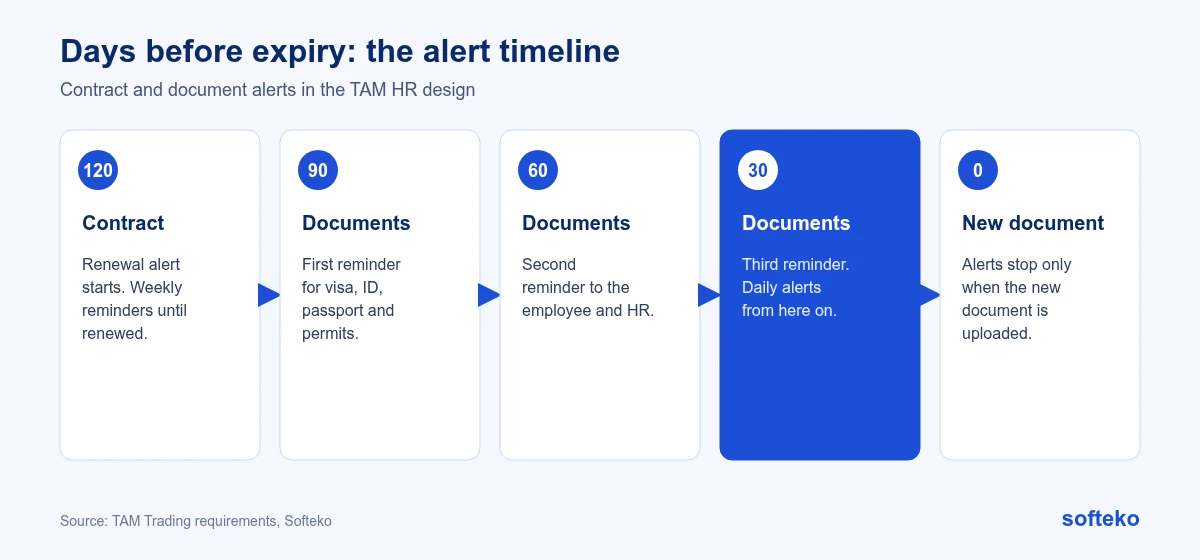
In Odoo, expiry dates can be stored on the employee record and the alerts built as scheduled actions that create activities for HR. The rule that alerts stop only when a new document is uploaded is part of the configuration.
Leave and attendance
The design accrues annual leave at 2.5 days per month and applies each country’s rules for sick, maternity and other special leave. Employees must submit leave plans by a deadline, with approval from HR and then senior management, to avoid sudden staff shortages during busy periods. Sick leave needs a medical certificate from the second day.
Attendance comes from biometric devices for office staff, with edits limited to HR and Admin and an audit trail kept.
How to set up monthly leave accrual in Odoo 19
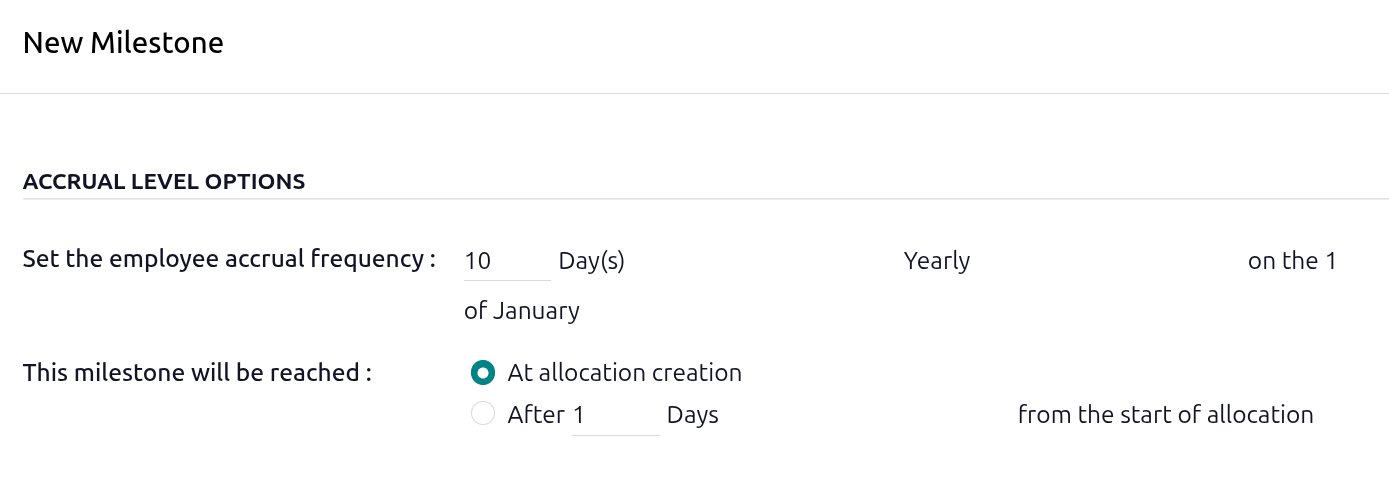
Odoo’s Time Off app uses accrual plans for this [6]:
- Go to Time Off › Configuration › Accrual Plans and create a plan.
- Add a level that grants 2.5 days each month.
- Set carry-over and any cap on the balance according to the country’s rules.
- Create an allocation for each employee, or group of employees, using the plan.
Use a separate plan per country if the rules differ, so a transfer between entities can switch the employee to the right plan.
If your HR team tracks visas and leave in separate sheets per country, we can show how the same rules would work in one Odoo database.
End of service and exit
End-of-service benefit is calculated from the last basic salary using each country’s legal rules. As one example, Odoo 19’s UAE payroll localization calculates 21 days of salary for each year of service between one and five years, and 30 days for each year beyond five, with no entitlement in the first year [1]. It also builds a monthly end-of-service provision [1]. The UAE government states that end-of-service dues must be paid within 14 days of the contract ending [2].
An illustrative example under those rules: an employee leaves after 7 years. The first 5 years earn 5 × 21 = 105 days of basic salary. Years 6 and 7 earn 2 × 30 = 60 days. The total is 165 days of basic salary. The Saudi localization also accumulates an end-of-service provision monthly [5].

TAM’s design adds a clearance block. The final settlement cannot be processed until digital sign-offs confirm that every company asset has been returned: laptop, SIM card, phone and anything else issued at onboarding. On the finance side, the design includes monthly provisions for leave salary, end of service and airfare.
Moving staff between entities
When an employee moves between entities, for example from the UAE to KSA, the design updates the country rules, cost centre and entitlements automatically and keeps the full history. Transfers need approval. Stock follows a similar intercompany pattern; see stock across UAE and KSA.
In Odoo, that means a new contract in the receiving company, with the right salary structure, leave plan and documents. The history stays on the employee.
Visitors and assets
Reception registers office and warehouse visitors (ID, purpose and host) through a restricted view that hides sensitive employee data. Company assets are issued with a digital acknowledgement at onboarding, which is what makes the clearance block at exit possible.
What standard Odoo 19 covers
Odoo 19’s payroll documentation lists localizations for the UAE and Saudi Arabia, among others [4]. The UAE localization covers end of service, provisions and the WPS salary file [1], and Odoo’s 19 release notes say the UAE WPS export was updated to align more closely with MoHRE rules [3]. Bahrain is not in that list, so Bahrain rules need configuration. Check the current list before planning. The trading side of the same project starts with one deal record.
| Area | Standard Odoo 19 | Needs configuration or development |
|---|---|---|
| UAE payroll and end of service | Localization available | Company-specific allowances |
| KSA payroll and end of service | Localization available | Company-specific allowances |
| Bahrain payroll | No localization | Salary rules and end of service |
| Leave accrual | Accrual plans | Country plans and approvals |
| Document expiry alerts | Dates on records | Alert schedule and stop rule |
| Exit clearance block | Not standard | Asset sign-offs before settlement |
Checklist for multi-country HR in Odoo
- List the rules per country: probation, leave, end of service, notice and documents.
- Check which countries have an Odoo payroll localization, and plan the gaps.
- Record every document with an expiry date and set the alert timing.
- Set up accrual plans per country.
- Issue assets with an acknowledgement, so exit clearance can be enforced.
- Decide what happens to rules and history when staff move between entities.
FAQ
Does Odoo 19 calculate UAE end-of-service gratuity?
Yes. The UAE payroll localization calculates end of service and a monthly provision [1].
Does Odoo 19 have Saudi payroll?
Yes. The Saudi Arabia localization is listed in the Odoo 19 payroll documentation, including an end-of-service provision [5].
Can Odoo accrue leave every month?
Yes. Accrual plans in the Time Off app can grant a set number of days each month [6].
Can Odoo block a final settlement until assets are returned?
Not as a standard rule. We specified an asset clearance block in TAM’s design.
Which GCC countries have an Odoo payroll localization?
The Odoo 19 documentation lists the UAE and Saudi Arabia, among others [4].
Keep every country’s HR rules in one place
If your HR team tracks visas and entitlements in separate sheets per country, we can show how the same rules would work in one Odoo database. See how we approach Odoo for trading and distribution projects.
References
[1] Odoo, United Arab Emirates payroll localization, Odoo 19.0 documentation. https://www.odoo.com/documentation/19.0/applications/hr/payroll/payroll_localizations/united_arab_emirates.html
[2] UAE Government, End of service benefits for workers in the private sector. https://beta.government.ae/en/information-and-services/jobs/end-of-service-benefits-for-employees-in-the-private-sector
[3] Odoo, Odoo 19 Release Notes. https://www.odoo.com/odoo-19-release-notes
[4] Odoo, Payroll, Odoo 19.0 documentation. https://www.odoo.com/documentation/19.0/applications/hr/payroll.html
[5] Odoo, Saudi Arabia payroll localization, Odoo 19.0 documentation. https://www.odoo.com/documentation/19.0/applications/hr/payroll/payroll_localizations/saudi_arabia.html
[6] Odoo, Accrual plans, Odoo 19.0 documentation. https://www.odoo.com/documentation/19.0/applications/hr/time_off/accrual_plans.html
[7] Screenshots: Odoo S.A., Odoo 19.0 documentation (Accrual plans, UAE payroll), licensed under CC BY-SA 4.0 (https://creativecommons.org/licenses/by-sa/4.0/). https://www.odoo.com/documentation/19.0/